
How to Prompt AI the Right Way: A Practical Guide to Better Results
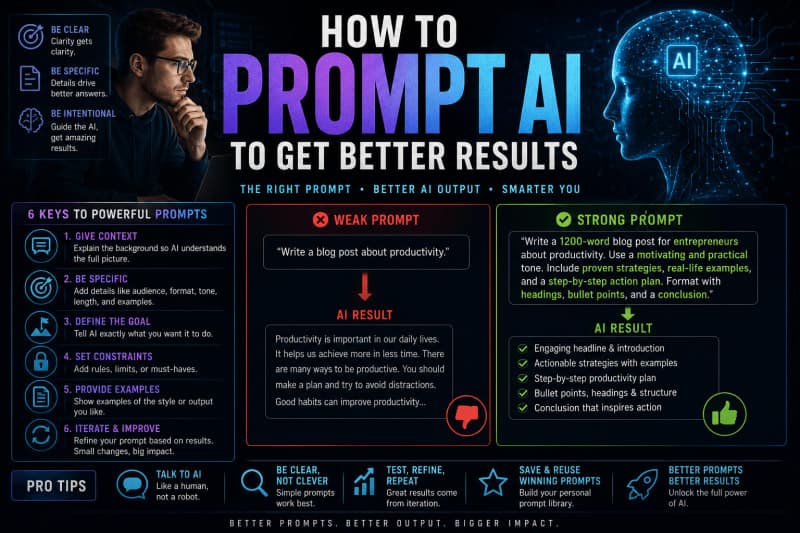
If you've ever asked an AI model a question and gotten a vague, generic, or just plain wrong answer, the problem probably wasn't the AI — it was the prompt. AI models are powerful, but they can only work with what you give them. The good news: prompting is a skill anyone can learn, and small changes to how you ask can dramatically improve what you get back.
Here's a practical breakdown of how to prompt better.
1. Be Specific, Not Vague
The single biggest mistake people make is being too general.
Weak prompt: "Write about marketing."
Better prompt: "Write a 300-word LinkedIn post about how small e-commerce businesses can use email marketing to recover abandoned carts, aimed at store owners with no marketing background."
The more specific your request, the less the AI has to guess — and the less it guesses, the better your result.
2. Give Context
AI doesn't know your situation unless you tell it. Who is this for? What's the goal? What's already been tried?
Instead of:
"Help me write an email to my team."
Try:
"Write a short, encouraging email to my 6-person design team. We just missed a deadline due to a client's late feedback, not our fault, and I want to keep morale up while resetting expectations for next week."
Context turns a generic response into a genuinely useful one.
3. Define the Format You Want
If you want a table, a list, a script, or a specific structure, say so explicitly.
- "Give me this as a bulleted list of 5 items."
- "Format this as a table with columns for Task, Owner, and Deadline."
- "Write this as a 3-paragraph blog intro, not an outline."
Without format instructions, the AI will pick its own — which may not match what you actually need.
4. Set the Tone and Style
Tone matters, especially for writing tasks. Tell the AI how it should sound:
- Professional and formal
- Casual and conversational
- Witty and playful
- Empathetic and supportive
For example: "Explain this refund policy to a customer in a friendly, apologetic tone — not legal or robotic."
5. Use Examples (Show, Don't Just Tell)
If you have a sample of what "good" looks like, share it. AI models are excellent at pattern-matching to examples.
"Here's an example of the style I like: [paste example]. Now write a similar post about our new product launch."
This is one of the most effective techniques, especially for writing tasks where tone or voice is hard to describe in words.
6. Break Big Tasks into Steps
Instead of asking for everything at once, guide the AI through a process — especially for complex or multi-part tasks.
Instead of: "Build me a marketing strategy."
Try:
- "First, list the key customer segments for a product like ours."
- "Now suggest one marketing channel for each segment."
- "Now turn this into a simple 4-week action plan."
Step-by-step prompting reduces errors and gives you more control over the direction.
7. Ask the AI to Think Before Answering
For anything involving reasoning, math, or decision-making, ask the AI to explain its thinking or work through the problem step by step before giving a final answer. This often improves accuracy significantly, especially on harder questions.
"Walk through your reasoning step by step, then give me your final recommendation."
8. Tell It What to Avoid
Sometimes it's just as useful to say what you don't want.
- "Don't use corporate jargon."
- "Avoid bullet points — write it as flowing paragraphs."
- "Don't include a conclusion paragraph."
Negative constraints help narrow down the output just as much as positive instructions do.
9. Iterate — Don't Expect Perfection on the First Try
Prompting isn't a one-shot process. Treat it like a conversation:
- "That's close, but make it shorter and punchier."
- "Good structure, but the tone is too formal — make it warmer."
- "Can you rewrite the second paragraph only?"
Refining through follow-up prompts almost always beats trying to write the "perfect" prompt from the start.
10. Give the AI a Role (When It Helps)
Assigning a role can sharpen the response by framing the perspective and expertise the AI should draw from.
"You are an experienced financial advisor. Explain the pros and cons of index funds to someone who has never invested before."
This isn't magic, but it does help calibrate the level of expertise, vocabulary, and focus.
A Simple Framework to Remember: T.C.R.E.I.
When in doubt, structure your prompt around these five elements:
- Task — What do you want done?
- Context — What background does the AI need?
- Role — Should it act as a specific type of expert?
- Examples — Can you show a sample of the desired output?
- Instructions on format — How should the final answer look?
Will AI Take Your Job? The Honest Truth About AI and the Future of Work in 2026
Final Thoughts
Good prompting comes down to one idea: treat the AI like a capable assistant who's smart but has zero background on your situation. The clearer, more specific, and more structured your request, the better your result will be.
Start specific, add context, define the format, and don't be afraid to refine your prompt over a few rounds. Prompting is a conversation, not a single perfect command — and getting comfortable with that mindset is the real key to getting consistently better results from AI.