How to Start a Journaling Habit That Actually Sticks (Even If You've Failed Before)
How to Start a Journaling Habit That Actually Sticks (Even If You've Failed Before)
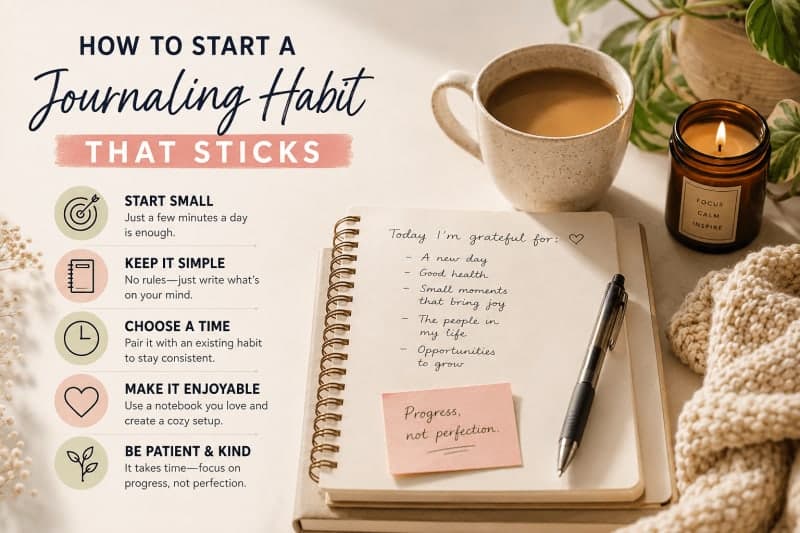
You've bought the notebook. You've watched the videos. You wrote three entries in January and haven't opened the journal since. If that sounds familiar, you're not lacking discipline — you're using the wrong approach. Building a journaling habit that lasts isn't about willpower. It's about removing friction, lowering the bar, and giving yourself permission to do it badly.
This guide walks through exactly why most journaling habits fail, and a simple system you can start today that's built to survive busy weeks, bad moods, and the inevitable days you just don't feel like writing.
Why Most Journaling Habits Fail in the First Two Weeks
Almost every failed journaling habit dies for the same three reasons: the entry feels too long, the blank page feels intimidating, and there's no clear trigger that reminds you to actually sit down and write. Fix those three things, and the habit becomes almost automatic.
Step 1: Shrink the Habit Until It's Almost Too Easy
The biggest mistake beginners make is starting with a full page. Instead, commit to writing just two or three sentences a day. A tiny, consistent habit beats an ambitious one you abandon after a week. Once three sentences feels effortless, you'll naturally want to write more — but the habit is already locked in by then.
"You do not rise to the level of your goals. You fall to the level of your systems." — James Clear, Atomic Habits
Step 2: Attach Journaling to Something You Already Do
Pick one anchor: your morning coffee, your commute, or right before you plug in your phone at night. Place your notebook (or journaling app) physically next to that trigger. The goal is zero decision-making — when the trigger happens, the journal is already in your hand.
Step 3: Use Prompts When You Don't Know What to Write
A blank page is the number one killer of journaling habits. Keep a short list of go-to prompts so you never have to stare at nothing. A few that work well for almost anyone:
- What's one thing that went better than expected today?
- What's currently taking up the most space in my head?
- What would make tomorrow 1% easier?
- What am I avoiding right now, and why?
Step 4: Track Streaks, Not Perfection
Missing one day won't break your habit. Missing two days in a row is what usually kills it, because the gap starts to feel normal. Use a simple habit tracker or even a checkmark on a calendar, and make your only rule: never miss twice.
Journaling by Hand vs. Journaling on an App: Which Should You Choose?
Both work — the right choice depends on what will actually get used consistently.
| Method | Best For | Watch Out For |
|---|---|---|
| Handwritten notebook | Slower, reflective thinking; no notifications or distractions | Easy to forget it at home; harder to search old entries |
| Journaling app | Reminders, searchable entries, always in your pocket | Can feel like "just another screen" and blur into scrolling |
If you're prone to distraction, start with paper. If you already carry your phone everywhere and need reminders to build the habit, an app will likely serve you better.
The Bottom Line
A journaling habit that sticks isn't built on motivation — it's built on a low bar, a clear trigger, and a simple rule for bouncing back after a missed day. Start with three sentences, attach it to something you already do, and give yourself permission to write badly. Consistency beats perfection every time.