The 5-9 Method: How to Reclaim Your Evenings After a 9-5 Job
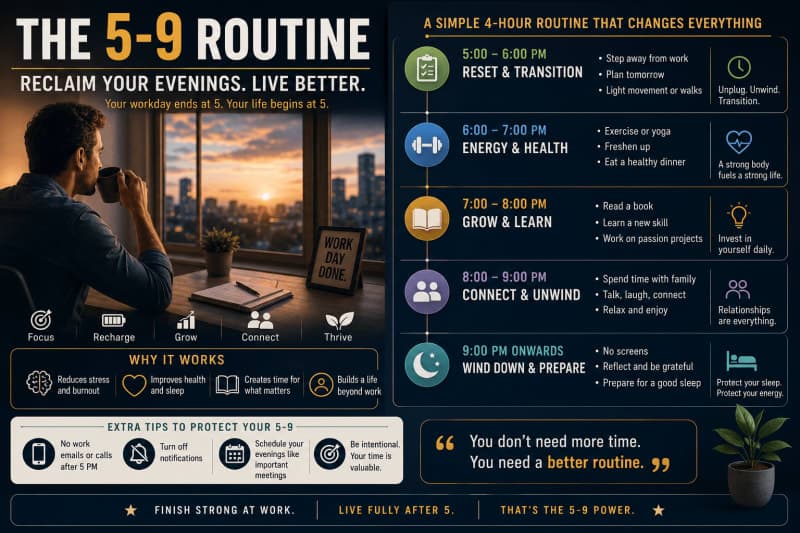
You clock out at 5. And then what? For most people, the honest answer is: scroll on the couch, half-watch something, eat dinner distracted, and suddenly it's time for bed — with no memory of the evening actually happening. The "5-9" trend flips that script. It treats the hours between the end of work and the start of sleep as their own deliberate block of time, not a leftover.
It's a simple idea, but building one that actually sticks takes a little structure. Here's how.
Why Your Evenings Disappear in the First Place
It's not laziness — it's decision fatigue. By 5 p.m., you've already made hundreds of small choices at work. Your brain doesn't want one more decision, so it defaults to the lowest-effort option available: the phone, the couch, the show that requires nothing from you. The 5-9 method works because it removes the decision-making in the moment — you're not choosing what to do at 5:15, you already decided that this morning.
Step 1: Build a Transition, Not Just a Task List
The biggest mistake people make when they try this is jumping straight from "work mode" into their evening plans with no buffer — and it doesn't work, because your brain is still running on work adrenaline. Give yourself a 10–15 minute transition: change out of work clothes, step outside for a few minutes, or just sit quietly with water before starting anything else. This one small habit does more to make an evening feel "yours" than anything that comes after it.
Step 2: Pick One Thing That's Just for You
Not a chore, not errands, not catching up on emails — one thing that exists purely because you enjoy it. This is where the trend gets its name: the block from 5 to 9 becomes personal time, the same way a lunch break is supposed to be. Popular versions people are trying right now:
- A short walk with no destination or podcast — just moving and thinking
- Cooking something slightly more involved than the fastest option
- A hobby with a visible, physical result — drawing, an instrument, a plant, a puzzle
- Time with a friend or partner that isn't just "being in the same room while on phones"
Step 3: Protect the Time Like It's a Meeting
If it's not scheduled, it gets swallowed by whatever's easiest — usually a screen. Block it on your calendar the same way you'd block a meeting, even if the "meeting" is just "walk + cook dinner." This sounds excessive for something as simple as an evening, but the people who actually keep a 5-9 routine going are almost always the ones who treat it as non-negotiable, not optional.
Step 4: Set a Screen Boundary, Not a Screen Ban
You don't need to swear off your phone for four hours — that's not realistic and it isn't the point. The point is making sure the phone is a choice, not a default. A simple rule that works well: no scrolling in the first hour after work, and no scrolling in the last hour before bed. What happens in between is up to you.
Step 5: Let the Routine Flex — Just Don't Let It Disappear
Some evenings will be a full 5-9 routine. Others will just be a 20-minute walk and an early night, and that's still a win. The goal isn't a rigid four-hour schedule you follow perfectly — it's making sure your evenings are something you're choosing, even in a small way, instead of something that just happens to you.
The Bottom Line
The "5-9" trend caught on because it names something a lot of people were already feeling: work ends, but the day doesn't actually start belonging to you again until you decide it does. You don't need a perfect routine or four extra hours of productivity. You need one small, protected pocket of time that's genuinely yours — and the rest tends to follow.