How to Fix Chronic Procrastination: A Step-by-Step Guide to Actually Getting Things Done
Why "Just Do It" Never Actually Works
You know the task needs to get done. You even want it done. And yet somehow you end up reorganizing your desk, deep-cleaning the kitchen, or falling into a three-hour internet hole instead. If willpower alone could fix procrastination, it would have worked by now — for you, and for basically everyone else who's ever tried it.
Here's the piece most advice gets wrong: procrastination isn't a time-management problem. It's an emotion-management problem. And once you understand what's actually happening in your brain, fixing it becomes a completely different — and much more solvable — project.
The Real Cause: You're Not Avoiding the Task, You're Avoiding a Feeling
Researchers who study procrastination have found it's driven primarily by a desire to avoid the negative emotions a task triggers — boredom, anxiety, self-doubt, frustration, insecurity — not by laziness or poor scheduling. Your brain treats "starting this task" as a small emotional threat, and delaying it provides instant, if temporary, relief.
This is why procrastination feels so irrational from the outside. You're not failing to see the consequences of delay — you fully know the deadline is real. Your brain is simply prioritizing immediate emotional comfort over a distant, abstract outcome, and that trade-off happens automatically, beneath conscious reasoning.
Step 1: Name the Actual Feeling You're Avoiding
Before trying any productivity technique, get specific about what emotion the task is triggering. Is it boredom? Fear of doing it badly? Uncertainty about where to even start? Resentment that you have to do it at all?
This single step matters more than any technique that follows, because the right fix depends entirely on which feeling is driving the avoidance. Fear of failure needs a different solution than boredom does — apply the wrong fix and nothing changes.
Step 2: Shrink the First Step Until Resistance Disappears
Most procrastination happens at the boundary of starting, not during the work itself — once people actually begin, they often find it's far less unpleasant than anticipated. Use this by making the entry point almost absurdly small:
- Instead of "write the report" → "open the document and write one sentence"
- Instead of "clean the whole house" → "put away five things"
- Instead of "start the workout" → "put on your workout clothes"
The goal isn't to trick yourself — it's to lower the emotional activation energy required to begin, since that threshold is where almost all procrastination actually happens.
Step 3: Make the Task Boringly Concrete
Vague tasks are a breeding ground for procrastination because your brain doesn't know where to enter, which itself triggers anxiety. "Work on the presentation" is vague. "Write three bullet points for slide 2" is concrete. Before starting anything, rewrite it as a specific, physical first action — not a goal, an action.
Step 4: Remove the Decision, Not Just the Distraction
Every time you have to *decide* whether to start a task, you create another opportunity to talk yourself out of it. Remove the decision entirely by pre-committing: put the task at a fixed time on your calendar, tell someone else you're doing it at that time, or set up your environment the night before so starting requires zero setup decisions the next day.
Step 5: Use a Timer to Bound the Discomfort
One of the most effective, well-studied methods for overcoming task-avoidance is committing to just 10-15 minutes, with full permission to stop afterward. This works because it directly addresses the real problem — the feared discomfort feels infinite in your imagination, but a timer makes it finite and known. Most people, once the timer goes off, choose to keep going anyway, because momentum is already established.
Step 6: Separate "I Don't Feel Like It" From "I Can't Do It"
Procrastination thrives on the false belief that you need to feel motivated before you can start. In reality, motivation much more often follows action than precedes it — the feeling of wanting to work usually shows up a few minutes after you've already started, not before. Waiting to "feel ready" is often just procrastination wearing a disguise.
Step 7: Forgive the Delay Instead of Spiraling Over It
This is the step people skip, and it's often the one that matters most long-term. Research on procrastination has found that people who are harsher on themselves after procrastinating tend to procrastinate *more* on the next task, not less — the guilt and shame create more negative emotion to avoid, feeding the exact cycle you're trying to break.
Instead of "I'm so lazy, what's wrong with me," try: "That happened. What's one small thing I can do right now?" Self-compassion isn't letting yourself off the hook — it's removing the extra emotional weight that makes starting even harder next time.
What This Looks Like Put Together
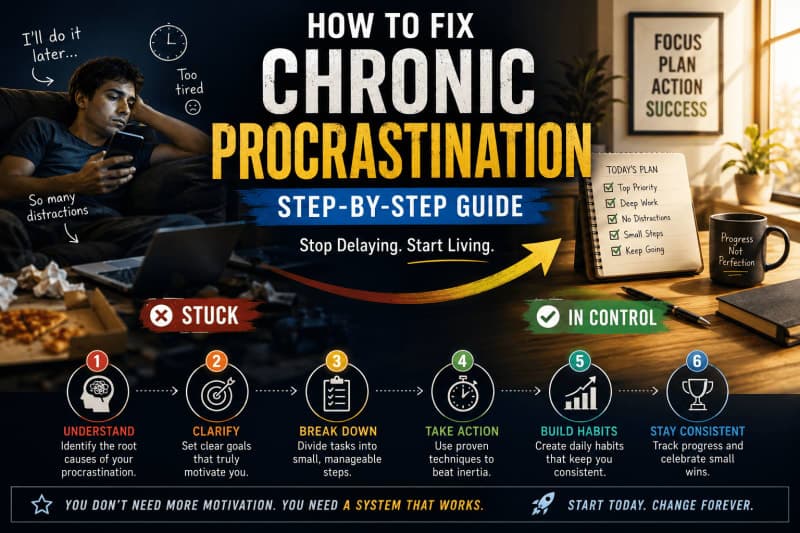
- Notice you're avoiding a task → name the actual feeling behind it
- Shrink the first step until it feels almost too easy to skip
- Make it concrete — a physical action, not a vague goal
- Pre-commit so you don't have to decide in the moment
- Set a 10-15 minute timer with permission to stop after
- Start before you feel motivated — motivation will likely follow
- If you slip, respond with compassion, not self-criticism
None of this requires becoming a different, more disciplined person. It just requires understanding that the task was never really the obstacle — the feeling attached to it was. Address that, and starting stops being the fight it used to be.
Start With Just One Task Today
Pick the one thing you've been avoiding longest. Don't aim to finish it — just name the feeling underneath the avoidance, shrink the first step down to something almost laughably small, and set a 10-minute timer. That's the entire system. The goal today isn't completion. It's just proving to yourself that starting was never as hard as it felt from the outside.