Will AI Take Your Job? The Honest Truth About AI and the Future of Work in 2026
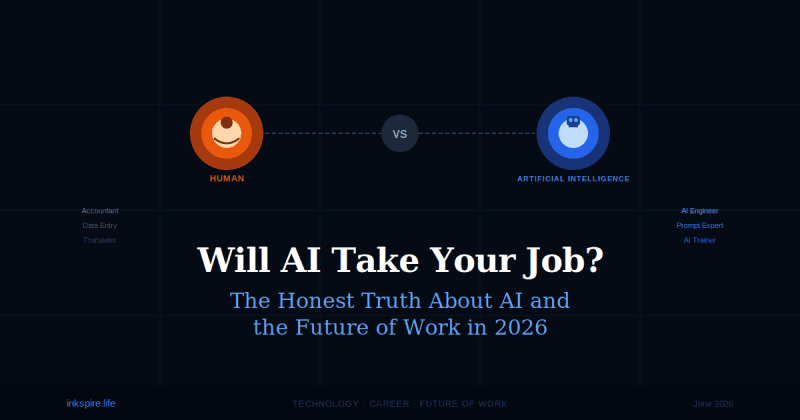
It is the question keeping millions of people awake at night in 2026. Every week there is a new headline — another company replacing workers with AI, another job category being automated, another skill made obsolete by a chatbot. So let us stop dancing around the question and answer it directly: Will artificial intelligence take your job?
The honest answer is — it depends. And understanding what it depends on could be the most important career decision you ever make.
What is Actually Happening With AI and Jobs Right Now?
AI tools like ChatGPT, Google Gemini, Claude, and hundreds of industry-specific tools have already fundamentally changed how work gets done. Companies are not just experimenting with AI anymore — they are deploying it at massive scale across every industry.
📊 The numbers are staggering: According to the World Economic Forum, AI and automation will displace approximately 85 million jobs globally by 2027 — but will also create 97 million new roles. The net result is positive — but only for people who adapt.
The key word is displace — not destroy. Most experts agree that AI will not eliminate jobs wholesale. Instead it will transform them — changing what workers do, how they do it, and what skills are valued. The workers who understand this are already positioning themselves. The ones who ignore it are taking a serious risk.
Which Jobs Are Most at Risk From AI?
Let us be completely honest. Some jobs are genuinely at high risk of being heavily automated or significantly reduced in the next 5 years. These tend to share common characteristics — they involve repetitive tasks, predictable patterns, and large amounts of data processing.
🔴 High Risk Jobs
Data Entry and Processing — AI can process, categorise, and enter data thousands of times faster and more accurately than any human. This category is already being dramatically reduced across banking, insurance, and logistics industries.
Basic Customer Service — AI chatbots now handle the majority of tier-1 customer service queries for major companies. They never sleep, never get frustrated, and cost a fraction of a human agent.
Translation and Transcription — Tools like DeepL and Whisper have reached near-human accuracy in many language pairs. Routine translation work is increasingly automated.
Basic Accounting and Bookkeeping — AI tools can now categorise expenses, reconcile accounts, and generate financial reports automatically. Basic bookkeeping roles are shrinking fast.
Paralegal Research — AI can review thousands of legal documents in minutes, identify relevant precedents, and summarise case law. Law firms are already reducing junior paralegal headcount.
Radiography and Medical Imaging Analysis — AI diagnostic tools are now detecting certain cancers and conditions with accuracy that matches or exceeds experienced radiologists in controlled studies.
⚠️ Important reality check: Being in a "high risk" category does not mean you will lose your job tomorrow. It means your role will change significantly and you need to start adapting now — not in five years when it is too late.
Which Jobs Are Safe — and Why?
Despite the headlines, there are large categories of work that AI genuinely cannot replace — at least not in the foreseeable future. These jobs share important characteristics: they require human judgment, emotional intelligence, physical dexterity in unpredictable environments, or deep creative originality.
✅ Safe and Growing Jobs
Mental Health Professionals — Therapists, counsellors, and psychologists work in deeply human, emotionally complex territory. While AI can assist, the therapeutic relationship requires genuine human empathy and presence that no algorithm can replicate.
Skilled Trades — Plumbers, electricians, carpenters, and mechanics work in unpredictable physical environments that require constant improvisation. Robots cannot yet climb into a crawl space and rewire a Victorian house. These jobs are extraordinarily safe.
Teachers and Educators — Great teaching is about relationships, motivation, and meeting students where they are emotionally and cognitively. AI can be a powerful teaching assistant — but it cannot replace a truly great teacher.
Nurses and Healthcare Workers — Patient care requires physical presence, emotional support, and split-second judgment in chaotic environments. Nursing is one of the most AI-resistant professions in existence.
Creative Directors and Senior Creatives — AI can generate content — but it cannot generate genuinely original creative vision, understand cultural nuance deeply, or take creative responsibility. Senior creative roles are growing, not shrinking.
AI Specialists and Prompt Engineers — Ironically, the biggest winners in the AI revolution are people who understand AI itself. AI engineers, data scientists, and prompt engineers are among the most in-demand and highest-paid workers on earth right now.
The Most Important Skill of the Next Decade
Here is the insight that most people miss when they think about AI and jobs. The question is not "will AI replace me?" The better question is: "How can I use AI to become 10 times more productive than my competitors?"
The workers who will thrive in the next decade are not the ones who resist AI — they are the ones who master it. A graphic designer who uses AI tools can produce in one day what used to take a week. A marketer who uses AI can test 100 campaign ideas where they used to test 10. A developer who uses AI coding assistants ships features in hours that used to take days.
"AI will not replace humans. But humans who use AI will replace humans who do not." — Unknown, but increasingly proven true every single day
How to Future-Proof Your Career Right Now
Whether you are a student, a professional, or someone mid-career — here are the most important steps you can take right now to make yourself indispensable in an AI-powered world:
1. Learn to use AI tools in your field. Whatever your job is — find the AI tools that are being used in your industry and learn them. Not later. Now. This single step will set you apart from the majority of your colleagues and competitors.
2. Develop uniquely human skills. Emotional intelligence, leadership, complex negotiation, creative problem-solving, and ethical judgment are skills that AI genuinely cannot replicate. Invest in these deliberately.
3. Become a specialist, not a generalist. Deep expertise in a specific domain is far more AI-resistant than being generally competent across many areas. Go deep in your field.
4. Build a personal brand. People trust people. A strong personal brand — a blog, a LinkedIn presence, a reputation in your community — creates opportunities that no algorithm can take away from you.
5. Never stop learning. The half-life of skills is shrinking. What was cutting-edge knowledge three years ago may be outdated today. Commit to continuous learning as a lifelong practice — not a phase.
🎓 Free AI courses to start today: Google offers free AI fundamentals courses at grow.google. Microsoft offers free AI certification at learn.microsoft.com. Coursera has free audit options for AI courses from Stanford and DeepLearning.AI. All completely free. All career-changing.
The Bottom Line
AI is not a threat to humanity. It is a tool — the most powerful tool ever created. And like every tool in history, from the printing press to the internet, it will disrupt some things and create extraordinary new opportunities in others.
The people who will struggle are those who wait for certainty before they act. The people who will thrive are those who get curious, get learning, and get ahead of the change before it arrives at their doorstep.
The future of work is not human versus AI. It is humans and AI — working together — doing things that neither could do alone.
The only question is: which side of that future do you want to be on?
"The illiterate of the 21st century will not be those who cannot read and write, but those who cannot learn, unlearn, and relearn." — Alvin Toffler
✨ Share this post with someone who is worried about AI and their career. It could change how they think about the future. More career guides and world insights every day at inkspire.life