How to Keep Mobile Phones Away From Babies: Best Practices and Screen-Free Activities That Actually Work
How to Keep Mobile Phones Away From Babies: Best Practices and Screen-Free Activities That Actually Work
Every parent has lived this moment: the baby starts crying in a restaurant, the phone is right there, and handing it over feels like the only fast fix. It works in the moment — and that's exactly why it becomes a habit so quickly. The real challenge isn't understanding that screens aren't ideal for babies; most parents already know that. The real challenge is figuring out what to do instead, in the actual chaotic moments when you need five quiet minutes.
This guide is built around that problem. It covers practical, realistic strategies for keeping mobiles and TV away from babies, plus a full list of screen-free activities organized by exactly the situations where parents usually reach for a screen — fussiness, travel, mealtimes, and needing a few hands-free minutes.
Why "Just Don't Use the Phone" Doesn't Work
Most advice about limiting baby screen time stops at "don't do it," which is true but not actually useful. The phone isn't handed over because a parent doesn't know better — it's handed over because it's fast, it's already in your hand, and it works instantly. Any strategy that doesn't account for those three things will fail the first time a real, hard, tired moment shows up.
The strategies below are built around that reality: they're designed to be just as fast and just as reliable as reaching for a phone, so they can actually replace it instead of losing to it.
"Play is the highest form of research." — Albert Einstein
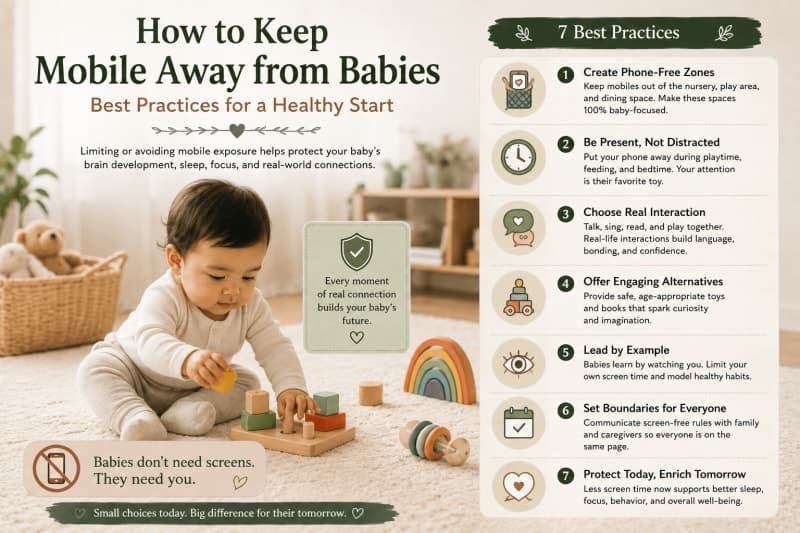
Best Practices to Keep Mobiles Away From Babies
1. Create Physical Distance, Not Just Willpower
Out of sight genuinely does mean out of mind, for both babies and parents. Keep your phone in another room, a bag, or a drawer during dedicated baby time instead of relying on yourself to simply not pick it up. Babies also notice and reach for phones specifically because they see adults using them constantly — reducing your own visible phone use naturally reduces their interest in it too.
2. Set Phone-Free Zones and Times
Pick a few non-negotiable windows — mealtimes, the first 20 minutes after waking up, and the hour before bed are good starting points — where the phone simply doesn't come into the room. These small, consistent windows matter more than one long screen-free day occasionally, because babies thrive on predictable routines.
3. Prepare a "Grab Bag" Before You Need It
Most screens get handed over during an unplanned crisis — a meltdown in a waiting room, a delayed flight, a long checkout line. Put together a small bag of 3–4 lightweight, screen-free items (a soft toy, a board book, a textured object) that lives in your diaper bag specifically for these moments, so you have something just as fast to reach for as a phone.
4. Address the Trigger, Not Just the Behavior
Before reaching for a screen, take two seconds to ask what's actually happening: Is the baby overstimulated, bored, tired, or hungry? Each of those has a different, more effective screen-free fix — a quiet, dim space for overstimulation, novel sensory play for boredom, a feed or nap for tiredness. A phone can distract from all four, but it doesn't actually resolve any of them, which is often why the crying comes right back the moment the screen is taken away.
5. Get Other Caregivers on the Same Page
Grandparents, babysitters, and partners often default to a phone specifically because they don't know what else works for your baby. Share your go-to screen-free activities with anyone else who spends regular time with your child, so the household approach stays consistent rather than falling apart the moment you're not the one holding the baby.
How to Keep Babies Busy Without Mobiles or TV
The activities below are organized by the specific situation that usually makes a screen tempting, so you can jump straight to whichever one you're dealing with right now.
When You Need a Few Hands-Free Minutes (Cooking, Cleaning, Working)
- Set up "yes space" floor time — a safe, contained area with 2–3 rotating toys where the baby can explore independently in view of where you're working.
- Give them a "busy basket" — a small container of safe household objects (wooden spoons, measuring cups, empty containers) that feel novel simply because they're not usual toys.
- Use a mirror — babies are often fascinated by their own reflection and can happily entertain themselves in front of a secured baby-safe mirror for several minutes at a time.
During Long Car Rides or Travel
- Narrate what you see — describing passing cars, trees, or buildings out loud gives babies language exposure and something to visually track.
- Attach soft toys to the car seat — textured, easy-to-grip toys clipped within reach keep hands busy without any screen involved.
- Sing familiar songs — repetition and rhythm are naturally soothing and don't require anything but your voice.
In Waiting Rooms or Restaurants
- Bring a dedicated "outing toy" — a small toy or board book kept specifically for outings feels novel every time because it's not part of the everyday rotation at home.
- Play simple peekaboo or clapping games — these require zero equipment and reliably hold a baby's attention in short bursts.
- Let them people-watch — babies are naturally drawn to faces and movement, and a busy room often provides enough stimulation on its own.
During Fussy or Overstimulated Moments
- Move to a quieter, dimmer space — overstimulation is often the actual cause of fussiness, and reducing input works better than adding a screen on top of it.
- Try skin-to-skin contact or a gentle carry — physical closeness is one of the fastest, most reliable ways to calm a distressed baby.
- Offer a repetitive, predictable motion — gentle bouncing, rocking, or swaying taps into a soothing reflex most babies respond to quickly.
Before Bedtime
- Build a short, consistent wind-down routine — the same 2–3 quiet activities each night (bath, book, lullaby) signal to the baby's body that sleep is coming, without any blue light involved.
- Read the same book repeatedly — predictability is calming for babies, and repetition also supports language development far more than passive video content does.
Screen-Free Activities by Age
| Age | Great Screen-Free Activities |
|---|---|
| 0–6 months | Tummy time, high-contrast cards, gentle singing, mirror play |
| 6–12 months | Busy baskets, stacking toys, peekaboo, textured board books |
| 12–18 months | Simple shape sorters, water play, pointing-and-naming games |
| 18–24 months | Pretend play, simple puzzles, crayon scribbling, sorting games |
What to Do When It Doesn't Go Perfectly
There will be days it doesn't work — a flight gets delayed three hours, or a meltdown happens somewhere with nothing to reach for but a phone. That's normal, and one screen-filled afternoon doesn't undo weeks of consistent habits. The goal isn't a perfectly screen-free household; it's making screen-free the default option so often that the occasional exception stays exactly that — an exception, not the pattern.
Frequently Asked Questions
What's the easiest first step to reduce phone use around a baby?
Start with one consistent phone-free window, like mealtimes, rather than trying to overhaul everything at once. Small, consistent changes tend to stick far better than an all-or-nothing approach.
What if my baby already expects a phone when upset?
Replace it gradually and consistently with the same alternative — like a specific soothing toy or a change of environment — so a new expectation has time to form. It will likely feel harder for the first several attempts before it gets easier.
Is it okay to use a phone sometimes, like on a long flight?
Occasional use isn't the concern researchers point to — the overall pattern is. Using a phone as an occasional tool during genuinely difficult situations is very different from it being the default response to boredom or fussiness at home.
The Bottom Line
Keeping mobiles and TV away from babies isn't really about willpower in the moment — it's about removing the phone as the easiest option and having a small, reliable set of screen-free alternatives ready before you need them. Start with one phone-free window, build a simple grab bag of go-to activities, and get every caregiver in your baby's life on the same page. The habit gets easier fast once screen-free becomes the automatic first move instead of the second thought.