Screen Time and Babies: Why Keeping Infants Away From Mobiles and TV Matters (Benefits, Risks, and Practical Tips)
Screen Time and Babies: Why Keeping Infants Away From Mobiles and TV Matters (Benefits, Risks, and Practical Tips)
It happens to almost every parent: the baby is fussy, dinner needs to get made, and the phone or TV is the fastest way to buy fifteen minutes of quiet. It's not a parenting failure — it's a survival tactic. But pediatric researchers have spent the last decade studying what early, frequent screen exposure actually does to a developing brain, and the findings are consistent enough that most major health organizations now give clear, specific guidance on it.
This guide covers why screens affect babies differently than older kids or adults, what the research says about the risks, the real benefits of limiting screen exposure early on, and practical, realistic ways to reduce it without losing your mind in the process.
Why Babies' Brains Respond to Screens Differently
A baby's brain forms more new neural connections in the first two years than at any other point in life, and it does this almost entirely through real, three-dimensional interaction — a caregiver's facial expressions, tone of voice, touch, and the back-and-forth rhythm of being talked to and responded to. Screens, even ones designed to look educational, are two-dimensional and one-directional. The baby watches, but nothing responds to them in return.
That missing back-and-forth matters more than it sounds. Language development in particular relies on what researchers call "serve and return" interaction — a baby babbles, a caregiver responds, the baby tries again. A screen can't serve that return, no matter how colorful or engaging the content looks.
"Technology is only a tool. In terms of getting the kids working together and motivating them, the teacher is the most important." — Bill Gates
Potential Side Effects of Early Screen Exposure
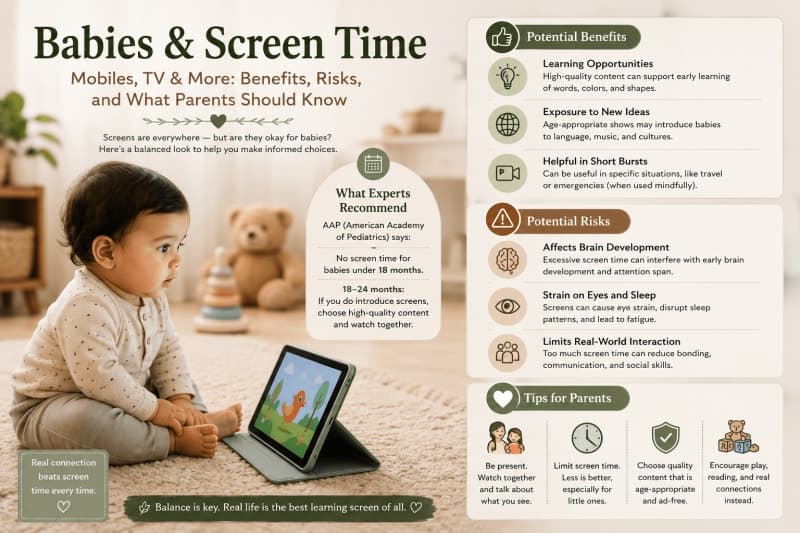
Research on early childhood screen use points to a handful of areas where frequent exposure is most consistently linked to negative outcomes:
- Delayed language development — babies exposed to more screen time, and less direct verbal interaction, tend to show slower vocabulary growth in early studies.
- Reduced attention span — the fast cuts and constant stimulation common in children's content can make slower-paced real-world activities, like books or quiet play, feel understimulating by comparison.
- Disrupted sleep — screen exposure close to naps or bedtime, especially from blue light, is associated with more difficulty settling and falling asleep.
- Less physical activity — screen time is passive time, which in infancy often displaces the tummy time, crawling, and movement that build early motor skills.
- Fewer real-world social cues — time spent on a screen is time not spent watching faces, which is one of the primary ways babies learn to read emotion and social cues.
The Real Benefits of Limiting Screens Early On
Flip the risks around, and the benefits of a low-screen early environment become fairly intuitive:
Stronger Language Development
Babies who get more direct conversation, narration, and back-and-forth babbling with caregivers consistently build vocabulary faster than babies with heavier screen exposure at the same age.
Better Sleep Quality
Without blue light exposure close to bedtime, babies tend to settle more easily and maintain more consistent sleep-wake rhythms.
Longer Attention Span
Slower-paced activities — stacking blocks, flipping through a board book, examining an object — help build the kind of sustained attention that fast-cut screen content doesn't require or reward.
More Physical Development
Unstructured floor time, crawling, and reaching build the motor skills and core strength babies need for walking, and that time has to come from somewhere — usually, from time not spent in front of a screen.
Stronger Parent-Child Bonding
Every minute not spent on a screen together is a minute available for eye contact, physical affection, and responsive interaction — the exact ingredients early attachment is built from.
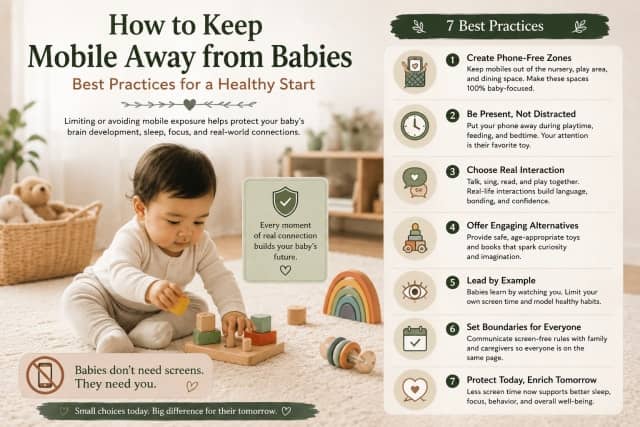
Practical Ways to Reduce Screen Time With a Baby
| Situation | Screen-Free Alternative |
|---|---|
| Need 10 minutes to cook or clean | Set up a safe play mat or high chair with a toy nearby, in view of where you're working |
| Long car ride | Sing, narrate what you see out the window, or use textured car toys |
| Waiting room or restaurant | Bring a small board book or soft toy specifically kept for outings |
| Winding down before bed | Replace screen time with a short, consistent book-and-lullaby routine |
| Background TV while parent relaxes | Turn the TV off when not actively watching, or use headphones for adult content |
What About Video Calls With Grandparents?
Most guidelines carve out an exception for video chatting. The reasoning is simple: video calls are interactive and responsive, not passive. A grandparent waving, reacting, and talking back to the baby in real time provides the "serve and return" interaction that passive shows and apps can't, which is why it's treated differently from typical screen time.
Frequently Asked Questions
Is any screen time okay for a baby under one year?
Most major pediatric guidelines recommend avoiding screen time entirely for babies under 18 months, with the exception of live video chatting with family members.
What age is screen time considered safer to introduce?
General guidance suggests waiting until around 18–24 months, and even then, starting with limited, high-quality, co-viewed content rather than independent screen use.
Does "educational" baby content make a difference?
Content quality matters more than nothing, but even well-designed educational content for babies under two hasn't been shown to provide meaningful learning benefits over real-world interaction, since babies this young learn best through hands-on, responsive engagement rather than watching a screen.
The Bottom Line
You don't need to be a perfectly screen-free household to raise a healthy, well-developed baby — occasional exposure isn't the concern researchers are pointing to. What matters most is the pattern: making real interaction, movement, and unstructured play the default, and treating screens as the occasional exception rather than the default fallback. Small, consistent choices in the first two years add up to a meaningful difference in language, sleep, and attention down the line.